


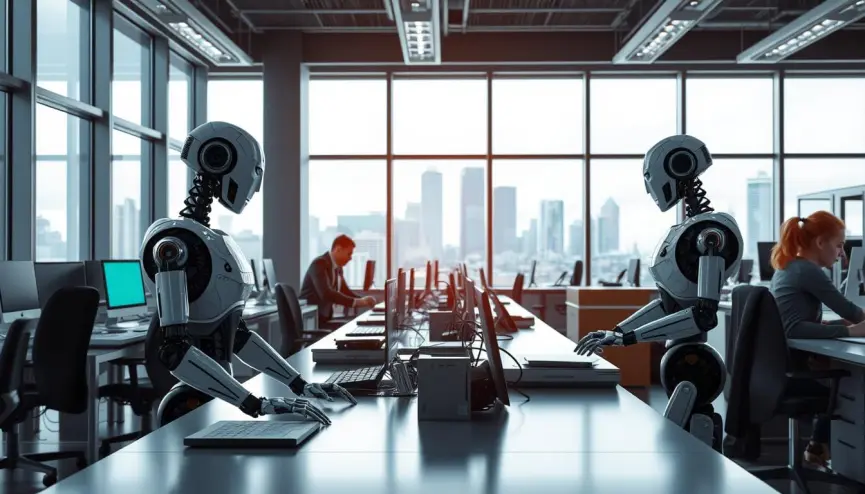
Artificial Intelligence (AI) is rapidly changing the global job market, transforming how companies operate and how people earn money. From automation in factories to AI-powered tools in offices, machines are now performing tasks that once required human effort. This shift is creating both opportunities and risks, especially for workers in traditional roles. Understanding why AI will replace many jobs—and how to prepare for it—is essential for anyone who wants to stay relevant in the future workforce.
How AI Is Changing the Job Market
Automation of Repetitive Tasks
AI systems are designed to handle repetitive and predictable tasks more efficiently than humans. Jobs involving data entry, basic customer support, and simple administrative work are increasingly being automated. This reduces costs for businesses but also decreases demand for human workers in these areas. As AI becomes more advanced, even complex repetitive processes are being handled with minimal human involvement, reshaping the structure of many industries.
Growth of Intelligent Software Systems
Modern AI tools are not just simple automation systems; they are intelligent platforms capable of learning and adapting. These systems can analyze data, generate reports, and even make decisions in certain scenarios. As businesses adopt these technologies, many traditional roles are being replaced or redefined. This shift means companies now rely more on software than on large human teams for operational efficiency.
Shift in Business Priorities
Organizations are increasingly focusing on speed, accuracy, and cost-effectiveness, which AI delivers more efficiently than manual labor. This shift is pushing companies to invest in AI-driven solutions instead of hiring for repetitive roles. As a result, job structures are evolving, and roles that do not require creativity or strategic thinking are becoming less necessary in the long term.
Jobs Most Affected by AI Automation
Administrative and Clerical Roles
Administrative jobs are among the first to be impacted by AI because they involve structured and repetitive tasks. Scheduling, documentation, and data processing can now be handled by AI tools with higher accuracy and speed. As automation improves, the need for large administrative teams is decreasing, especially in corporate environments.
Customer Support and Service Jobs
AI chatbots and virtual assistants are transforming customer service departments. These systems can handle thousands of queries simultaneously, reducing the need for human agents. While complex issues still require human intervention, a large portion of basic customer interactions are now managed by AI systems, leading to reduced hiring in this sector.
Entry-Level Data and Analysis Jobs
AI tools can now process large datasets and generate insights in seconds. This has reduced the demand for entry-level analysts who traditionally performed manual data sorting and reporting tasks. As AI continues to improve, even advanced analysis tasks are becoming increasingly automated, making this field more competitive and technology-driven.
What You Should Do to Stay Future-Proof
Learn AI-Complementary Skills
Instead of competing with AI, it is important to learn skills that work alongside it. Skills such as digital marketing, content strategy, creative thinking, and problem-solving are becoming more valuable. These abilities cannot be fully replaced by machines, making them essential for long-term career stability in an AI-driven world.
Focus on Creativity and Critical Thinking
AI is powerful at processing data but weak in emotional intelligence and creative decision-making. Developing strong creative and analytical thinking skills will help you stay relevant in the job market. Careers that require innovation, strategy, and human judgment are less likely to be replaced by automation.
Embrace Continuous Learning
The job market is evolving faster than ever due to AI advancements. Continuous learning is no longer optional—it is necessary. Staying updated with new tools, technologies, and industry trends will help you adapt quickly and remain competitive in changing work environments.
The Future of Work in an AI-Driven World
Human-AI Collaboration
The future of work is not about complete replacement but collaboration between humans and AI. Many industries are adopting hybrid systems where AI handles repetitive tasks while humans focus on strategy and creativity. This partnership increases productivity and allows businesses to operate more efficiently.
Rise of New Career Opportunities
While AI is replacing some jobs, it is also creating new ones. Careers in AI development, machine learning, cybersecurity, and digital transformation are growing rapidly. These roles require specialized skills and offer high demand in the global job market.
Transformation of Traditional Industries
Industries such as healthcare, education, finance, and marketing are undergoing major transformations due to AI integration. Instead of eliminating jobs entirely, AI is reshaping roles and responsibilities, requiring workers to adapt to new tools and workflows to stay relevant.
FAQs
1. Will AI completely replace all jobs?
No, AI will replace some jobs but also create new opportunities in different fields.
2. Which jobs are most at risk from AI?
Repetitive and routine jobs like data entry, basic support, and clerical work are most affected.
3. How can I prepare for AI in the workplace?
Focus on learning digital skills, creativity, and problem-solving abilities.
4. Is AI a threat or opportunity?
AI is both a threat and an opportunity depending on how individuals adapt to it.
5. What new jobs will AI create?
AI will create jobs in machine learning, automation, data science, and digital strategy.
Conclusion
AI is reshaping the global job market by automating routine tasks and transforming how businesses operate. While many traditional jobs may disappear, new opportunities are emerging for those who are willing to adapt and learn new skills. The key to surviving and thriving in this changing environment is continuous learning, creativity, and the ability to work alongside AI rather than against it.
